
Nearly Everything I Know About How to Improve Democracy
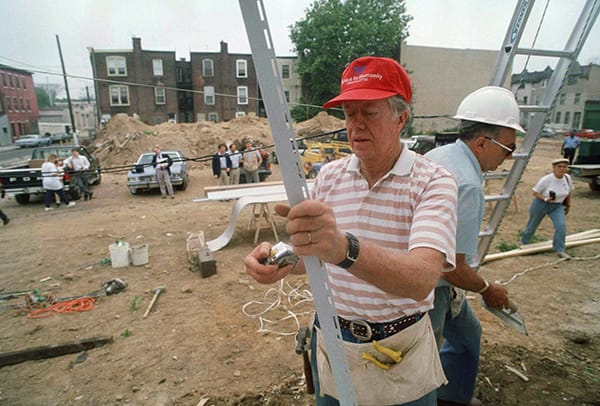

Let’s say I give you a toolbox with a hammer, wrench, screwdriver, and I tell you to build a house. That’d be awfully tricky to do.
And that’s a bit like what we’re given when it comes to shaping our democracy: an incomplete toolbox. Vote, protest, click this link to send a note to your Senator. Those are useful, but they are an incomplete arsenal for bettering our democracy.
Now here’s the rub: high-powered lobbyists have a much fuller toolbox. And they’re very good at wielding a wide range of tools to benefit their moneyed clients.
But policy that serves the powerful is rarely policy that serves the people.
So today, let’s fill out our toolbox. Because the health of our democracy depends, in no small part, on we the people using the power democracy gives us.
We’ll start with more familiar tools - and I’ll toss in some lesser known uses of them - and then we’ll build up to some nifty unfamiliar tools.
Vote
Especially in local and state elections, off-year elections, and primaries, when only the dedicated few tend to show up and a small number of votes can have big impact.
Power Moves: Call your town clerk to find out when the next election is. Mark your calendar a week before early voting starts. When that date arrives, send out a note to the folks you know in town with what’s on the ballot, when and where they can vote. You can even toss in your voting recs! Here’s a deeper dive on how to do that.
Run for Office
A healthy democracy depends on good, useful friction between ideas; that friction is baked into our political system through elections. But for ideas to get that necessary stress-testing, we need more than one candidate vying for a seat, whether water district, state rep, or U.S. Senator.
And we, dear reader, are a great many miles from that health marker. A pick-your-jaw-off-the-floor 68% of races in 2025 were uncontested.
Power Move: Call your town clerk - rapidly becoming a dear friend - to find out what races are up next election cycle, who’s already filed papers to run, what it takes to throw your hat in the ring (which I hope you’ll consider). If running isn’t right for you, here’s how to encourage someone else to get in.
Know Who Represents You in Local, State, and Federal Office
We live in a representative democracy, meaning we elect politicians to represent our voice in shaping the laws we live under. But they can’t represent us if we don’t know who they are.
We might think Congress is filled with the Big Dogs, so they’re the ones to focus on; everybody else is just small potatoes. But Congress only passes 1-2% of bills (and at the time of this writing, has only passed 38 bills - not 38 percent - 38 bills, this session).
So state legislators are doing the heavy lifting on deciding who can have guns and abortions, who can marry who, what’s taught, and much, much more. But only 20% of Americans can name their state legislators. Learning who they are is the first step to influencing how they vote.
Power Moves: Click here to find out who represents you in your state legislature and Congress. For local office, check your town’s website. Or call your new bestie, the town clerk.
Extra credit: Subscribe to your local paper. More than most any other outlet, their job is to hold the powerful to account in the region the paper serves, which is - conveniently - the region the politician also serves. (Here’s why that subscription helps shore up our democracy.)
Learn What Matters to Your Politicians
Now we’re stepping into Democracy 201. Politicians are dropping clues all over about what matters to them. The bills they cosponsor, the district sights they visit, their social media posts, press releases – these are all data points about how they see the world and what their priorities are in it.
The more we know about how they make meaning of what’s happening, the better positioned we are to shape an ask that fits into the world as they see it.
Power Moves: Sign up for your politicians' newsletters. It’s filled with intel on what they value and prioritize. Find out what Committees they serve on; that’ll tell you what issues they believe are most important.
Strategically Make Your Voice Heard with Your Politicians
Elected officials are given many powers; reading minds isn’t one of them. So it’s on us to respectfully let them know what we’re thinking.
It’s easy to call or email politicians and feel like we’re yelling into the void. Enough of that.
I worked in Congress for six years, have been lucky to know politicians and their staff up and down the ballot, and here's a high-impact way to register your opinion with them.
Power Move: Don’t forget to say thank you. Nine times outta 10, politicians only hear from upset constituents. Which is well within people’s right. But if we want to keep a politician doing the stuff we like and if we want to keep good politicians in the game, gratitude can go a long way. Here’s a great way to say thanks.
Understand the Power of Staff
When I worked in Congress, folks always wanted a meeting with my boss. But I’d take a staff meeting over a politician meeting any day of the week.
Staff do the lion’s share of the work, then pass the baton to the politician to take it across the finish line. Staff also know the politician better than we do. So if we can get staff buy-in, they can help get the big boss’s buy-in.
Plus, staff are way easier to get a meeting with than the top banana.
Power Move: If you want to meet with one of your Members of Congress, you don’t need to fly to D.C. Get a staff meeting in the district. It drives home that this is a district issue impacting district voters. Not some D.C. lobbyist issue. District staff also tend to stay around a lot longer than D.C. staff, so they tend to know the politician pretty well.
Things We Can Ask Politicians To Do Beyond Supporting a Bill
Legislators are in the business of legislating. Or at least they should be. But there are a host of other things they can do for the good of our democracy.
Raise the visibility of an issue by making statements and posting about it. Members of the Tea Party relentlessly talked about the national debt; ditto Senator Bernie Sanders talking about millionaires and billionaires.
Convene stakeholders. With gnarly issues, it’s a challenge to find someone with the heft to get impacted parties around the same table. Politicians can do that.
Build enthusiasm among their peers. Most politicians are pack animals, they don’t want to stick out too much from the herd. (More on understanding how politicians think here!) Or as Congressman George Miller put it: “We’ve got a hedge clipping service around here. When someone sticks his head up, sooner or later someone comes around and cuts it.”
So when another politician vouches for an issue, it’s like a Good Housekeeping Seal of Approval: this issue is safe to engage on.
Power Moves: If you have a big reach of an ask for a politician - cosponsoring a bill on a issue they’ve never engaged on, for example - a first step could be asking them to talk with another politician you know they’re close with who’s a leader on the issue. (And we know they’re close with that politician because we’ve spent time learning up what matters to our politician!)
To understand democracy is to understand how power is organized. The hitch is that we the people have been leaving power on the table. Not intentionally, but because we aren’t taught that these powers even exist.
So now you’ve got a slightly fuller toolbox now. May you go build something beautiful for our democracy.
Want to make a greater impact? Forward this newsletter along to one friend who could use it. Or you can gift it for the holidays!